Showing posts with label hybrid. Show all posts

Tuesday, 19 March 2013

Holy Crap: Duncan's Sewage Treatment Ponds

Last Sunday, I decided to reward myself for putting in a day of shopping for my upcoming trip to Thailand.  My plan for the day was to seek out crossbill flocks around Shawnigan Lake due to the prevalence of Western Hemlocks (Tsuga heterophylla).  The White-winged Crossbill (Loxia leucoptera) irruption this year spurred me to check this area because hemlocks are the conifer of choice for that species.  It was a total bust due to my impatience and the lack of good treetop viewing conditions.  I only had two Red Crossbills (L. curvirostris) in the area.  My consolation for the area was a Hutton's Vireo (Vireo huttoni) on West Shawnigan Lake Rd.

Due to the lack of crossbill action, I quickly cut the reigns on my idea and decided to head up to Duncan.  I opted to take a side route in to the town, passing Cowichan Bay on the way.  I turned on to the Cowichan Bay Dock Rd. (Westcan Terminal Rd. on Google Maps) and immediately was deterred by the horde of cars parked by the gate.  I decided to continue on and found a trail I had never taken before around a kilometre further along Tzouhalem Rd.  The trail follows a dike around one of the Dinsdale's farm fields, if memory serves me correctly, and it overlooks a section of the Cowichan River estuary that I have never checked before.  The outing wasn't overly productive, but I turned up a couple of Sharp-shinned Hawks (Accipiter striatus), three male Eurasian Wigeons (Anas penelope) among 90 or so Americans (Anas americana), and the most intriguing was a flock of 20+ American Pipits (Anthus rubescens) that vanished into the relatively short grass.  Normally I wouldn't say that a flock of pipits is intriguing, but the paucity of reports this winter locally paired with the fact that the Citrine Wagtail (Motacilla citreola) is still in the farm fields near Courtenay made me really want to scan through them carefully.  Perhaps there's something interesting like a japonicus American Pipit mixed in?  Unfortunately I only managed to see only two or three of them peeking up above the grass.  Very frustrating!

I was feeling a little defeated after putting in a pretty solid day's effort and coming out pretty empty-handed, so I decided to hit up the Duncan sewage treatment ponds as a last resort.  I think most people know how enamoured birders are with garbage dumps and sewage treatment facilities, but there is a reason!  Birds find our toilet flushings to be the best thing since sliced bread.  I think that saying even works because gulls and ducks love bread.

Look at all those gloriously disgusting scaups and gulls drawn to our waste!

I am now back from Thailand and see that I did not complete this post.  Nice!  I guess three weeks late is better than no post at all.  So, rather than wax poetic about fuzzy details, I'll just get to the stars of the show. One bird that immediately jumped out from the group of gulls closest to the corner I was viewing the ponds (near the Freshwater Eco-Centre) was a second-winter Glaucous Gull!

The overall creamy white colouration and pale iris point to this Glaucous Gull being a second year.

Mmmm... Duncan leavings!


Can you tell the Glaucous Gull ruled the roost?

The other bird was found while carefully scanning through the Lesser Scaups (Aythya affinis) and Ring-necked Ducks (A. collaris) for something like a Tufted Duck (A. fuligula).  One bird had a dark back much like a Ring-necked Duck, but everything else about it was more scaup-like.  It turned out that it was both - a hybrid Ring-necked Duck x Scaup sp.!  Have a look for yourself:

You'll have to forgive the quality, but the bird was quite far away!  The second duck from the left on the back pipe is the hybrid.  You can see the mantle shade is lighter than the black chest, the bird has a broad pale band on its bill, and lacks the obvious white shoulder spur of a Ring-necked.  For reference, you can see all the other birds on the pipes are Lesser Scaup with the exception of the rightmost bird on the second closest pipe (I'm including the pipe you can only see a sliver of in the bottom left), which is a Ring-necked Duck.

Flapping, but blurry so you can't really get much out of it.

You can see the broad pale band on the bill a little better here.

And just one last horrible record shot just for in case it adds a little something.

If you want to see the Glaucous Gull, it has now probably moved its way up to the Parksville-Qualicum area, so head up there for some great gulling in the next few weeks!

Sunday, 21 October 2012

Crosses and Crossbills

I'm back on familiar birding grounds and making up for lost time.  On Friday, I stopped in at the Vantreight bulb fields and had my first self-found Yellow-headed Blackbird (Xanthocephalus xanthocephalus) in a sizable blackbird flock and yesterday (Saturday) I met up with Jeremy K. and did the Sooke-Metchosin-Esquimalt circuit to see if we could turn up any interesting fall birds.

Our day started with a frigid stroll to the tip of Whiffin Spit and back.  This walk always seems to be the football equivalent of a Hail Mary pass - nine times out of ten it doesn't pan out, but the rewards are huge for the one time you make the pass.  Today was not the big payoff we had hoped.  Bird activity was plentiful with flocks of Zonotrichia sparrows, but we just couldn't seem to dig out anything unusual.  We did manage to start a running theme for the day here when we saw a Sharp-shinned Hawk (Accipiter striatus) cruise over, followed by a few Bald Eagles (Haliaeetus leucocephalus), and a Merlin (Falco columbarius) zipped through in pursuit of a morning meal.  Every stop hereafter we managed to see a raptor of some sort.

A stop in at the Goodrich Peninsula wasn't quite as brisk as Whiffin, but the level of success was similar.  My personal highlights for this stop were a lone Bonaparte's Gull (Chroicocephalus philadelphia) flying over the marina and a flock of Black Turnstones (Arenaria melanocephala) and Surfbirds (Aphriza virgata) on the floating logs by the docks.

We continued on to Metchosin via Lindholm Rd. and stopped to check out the small farm pond near the Galloping Goose crossing.  The pond was quiet but we located a huge, uncooperative blackbird flock.  We only managed short, partial views of the flock and consequently came up empty.

The best stop of the day was Swanwick Rd.  We started with a nice flock of geese on the main field, which contained 26 Greater White-fronted Geese (Anser albifrons) and 30 Cackling Geese (Branta hutchinsii) in with the usual Canada Geese (B. canadensis).

Three species of goose in one flock is always a nice sight!

My personal highlight for the day came next as three Red Crossbills (Loxia curvirostra) descended from the top of a conifer to a couple of puddles right in front of us.  I believe it was a family group as there was a single juvenile bird with an adult male and female.

The male Red Crossbill is the reddish bird with dark wings, while the streaky, olive-infused is a juvenile.

Here's a better look at the streaky appearance of the juvenile Red Crossbill.

This is the female Red Crossbill and she is really showing off her namesake crossed bill!

Swanwick Rd. was also our best raptor location of the day with two Red-tailed Hawks (Buteo jamaicensis), a Sharp-shinned Hawk, a Cooper's Hawk (Accipiter cooperi), a Peregrine Falcon (F. peregrinus), and seven Turky Vultures (Cathartes aura).

After a rather fruitless stop in at Albert Head Lagoon, we finished our day off at Esquimalt Lagoon.  The high  tide limited the amount of birds along the shore and the close flocks of ducks and gulls all seemed to be at the north end of the lagoon.  We were starting to study a male Eurasian x American Wigeon (Anas penelope x A. americana) when a Bald Eagle put all the birds.  I managed one distant shot that shows some of the key characteristics, including mottled grey and pinky-brown flanks and oddly-coloured head pattern.

Note the male's (right) largely grey flanks which is a feature of a Eurasian Wigeon, whereas the head pattern is closer to that of an American Wigeon.  This bird looks much less Eurasian-like than most reported hybrids.

After the dust settled from the eagle stir-up, I noticed an adult Thayer's Gull (Larus thayeri) had landed on the shore.  Shortly after, I found a nice American Herring x Glaucous-winged Gull hybrid (L. smithsonianus x L. glaucescens).  After commenting on its identification to Jeremy K., a classic adult Western x Glaucous-winged Gull (L. occidentalis x L. glaucescens) joined the other bird.  I couldn't pass up the opportunity to photograph the two side by side!

The dove-headed look is a good way to distinguish Thayer's Gulls from the more block-headed American Herring Gulls.  With experience, this species is not too hard to identify (with exceptions of course) but it is hard to tell you exactly why it is a Thayer's and not one of superficially similar species.

The left bird is a typical Western x Glaucous-winged Gull based on the mottled head and not overly dark mantle, while the right bird appears to be an American Herring x Glaucous-winged Gull due to the slight fading to the primaries and dark eyes.

Here is a closer view of the American Herring x Glaucous-winged Gull hybrid, which shows the slight fading in the primaries mentioned above.  The structure of this bird is more representative of its American Herring side as it is more slender than you'd expect for a Glaucous-winged.

That's all I have from this weekend's outings.  I hope to get out during the week, but whether I'll have anything worthy of posting is another story altogether!

Saturday, 31 March 2012

Spaghetti Western

This morning I toured around the Metchosin area in hopes of catching up with a couple spring birds.  My first stops provided a combination of lingering winter fare and resident birds.

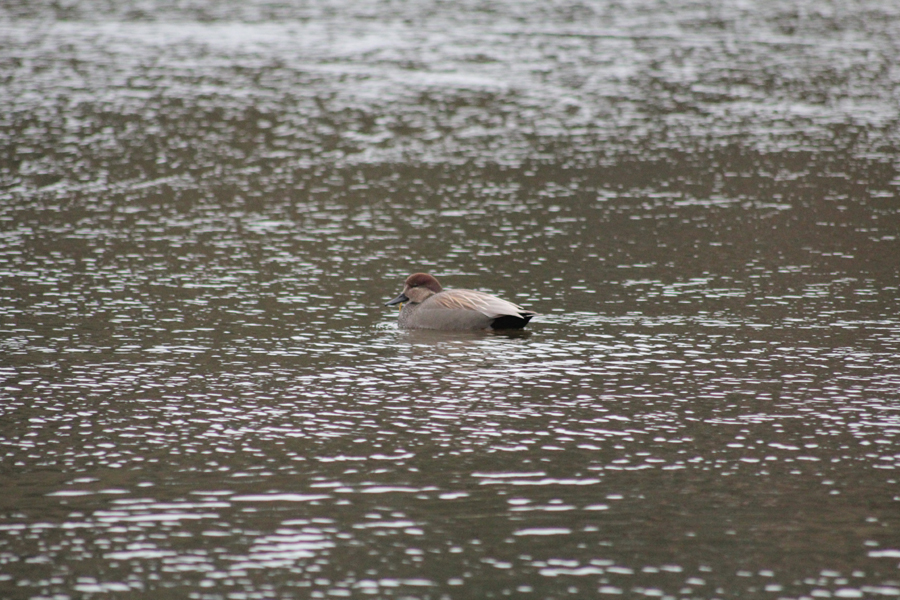
Gadwalls (Anas strepera), such as this male, are a resident species of waterfowl to the Victoria area

My luck changed near Weir's Beach when I heard the distinctive whir of a Rufous Hummingbird's (Selasphorus rufus) wings.  I scanned through a patch of flowering Salmonberry (Rubus spectabilis) and spotted a male darting from flower to flower.

With a bit of persistence, I eventually managed this capture of the male Rufous Hummingbird visiting a Salmonberry blossom

The Salmonberry flowers were looking so vivid and fresh that I couldn't help but take an extra shot or two.  I'm sure you'll agree it was worth the effort!

The flowering of Salmonberry is perfectly synchronized with the arrival of Rufous Hummingbirds

I detoured over to the Goodrich Peninsula in hopes of finding Mountain Bluebirds (Sialia currucoides) due to their presence a couple kilometres away at Whiffin Spit.  There were no bluebirds to be found, but I did have my first Yellow-rumped Warbler (Setophaga coronata) and migrating Savannah Sparrow (Passerculus sandwichensis) of the year.  Fox Sparrows (Passerella iliaca)were in abundance again at this location, including a couple singing males.

One of the Fox Sparrows was kind enough to pose for a minute on one of the many Himalayan Blackberry (R. armeniacus) shrubs

I finished my day off at Esquimalt Lagoon where I decided to take some photos of a couple birds that would likely be identified as Western Gulls (Larus occidentalis) to the laybirder.  I personally have no idea where the spectrum of northern Western Gulls (ssp. occidentalis) stops and hybrids with Glaucous-winged Gulls (L. glaucescens) - also known as Olympic Gulls due to their prevalence around the Olympic Peninsula - begin in terms of mantle shade.  Personally, I felt these were Spaghetti Westerns.  That's really just a term I made up, but I think it's suitable.  In birding, if someone deceptively reports a bird, it is termed "stringing".  During big days (a competition to see who can find the most birds in a day), I'm sure a few stringy Western Gulls sneak onto lists.  Spaghetti is stringy, hence Spaghetti Western.  The birds I saw today appear quite similar to a typical Western Gull, but the mantle shade is a touch paler, the primaries (wingtips) don't quite seem truly black, and the orbital ring appears to have a touch of pink mixed in the yellowish tone.  It is subtle but it would be more apparent if it was side-by-side-by-side with a Western and a Glaucous-winged for an idyllic comparison.  Here are two examples of Olympic Gulls:

The hot Jerry Springer topic in the bird world is: interspecies relationships

This one's bill is a little more orange, but the wingtips are a bit greyer

If I get the chance in the next while, I'll try to get a photo of what I believe to be a pure Western Gull for comparison.  Enough of the gulls, though. Also at the lagoon, there is a big flock of blackbirds and starlings and they are quite entertaining to watch.  Surprisingly, there was a nice adult male Brown-headed Cowbird (Molothrus ater) in the mix, but it flew a second after I noticed it.  I did, however, get a couple shots of male Brewer's Blackbirds (Euphagus cyanocephalus), so that will be the finale for this entry.

For something called a "blackbird", they have a lot of nice colours coming off those feathers

Saturday, 18 February 2012

Gull Bladder

I have a weak gull bladder so I decided to drain my urge today with a scan through any flocks I could come across.  Over the last week, a Glaucous Gull (Larus hyperboreus) has been sighted among the usual Mew (L. canus), Thayer's (L. thayeri), American Herring (L. smithsonianus), and Glaucous-winged Gulls (L. glaucescens) on the Saanich Peninsula.  Glaucous Gulls are an expected but scarce winter bird on southern Vancouver Island, with only a few records occurring in a typical winter.  As the etymology of 'hyperboreus' implies, they  come "from the north" after breeding in the high arctic.

Locally, the method for finding unusual gulls in a flock usually involves looking for pale or dark-backed individuals.  Glaucous Gulls fall into the former category.  Today I could only find one decent-sized flock of gulls on the polo field adjacent to Maber Flats in Brentwood Bay.  Scanning through the group, nothing really jumped out.  The Glaucous Gull was originally located near Maber Flats by Mary Robichaud on Friday, February 10th and it later was seen by several others when it was relocated at the Vantreight bulb fields a few days later by Kirsten Mills.  When I passed by the Vantreight bulb fields off Central Saanich Rd., I saw a whopping six gulls on one field and once again nothing jumped out of the mix.  After wandering around Sidney for a couple hours and having a bite to eat, my day ended with a check at Patricia Bay.  Last year in March, I found a first-winter Glaucous Gull at the mouth of Wsikem Creek where it drains into the bay.  I hoped to relive the magic but was a little deflated when I got to bay and saw all the gulls were heavily backlit by the low sun to the west.  I still gave my best effort and could see one gull that was intriguing.  I made my way down to the beach and walked out towards the sparse flock of gulls until the viewing conditions improved and the bird in question could be identified.  The overall paleness of the bird was not a trick of the light - the wingtips were nearly pure white, the body appeared to be uniformly dingy white, and its bill was pink with a black tip.  A perfect specimen of a Glaucous Gull.  I think it was a second-winter bird but I'd like to see it in better light to slap a proper age label on it.  I wasn't able to get a photo due to the low light, but I will share a couple shots of the first-winter bird from March last year at the same location:

This classic first-winter Glaucous Gull is distinguished by its white wingtips, white mantle with grey-brown vermiculations, sharply bicoloured bill, and overall bulk (approximately the same size as the hybrid Glaucous-winged x Western Gull to right)

The bird is aged as a first-winter Glaucous Gull by its dark eye; typical second-winter birds have a pale iris

The sighting gave my gull bladder the sweet relief I needed.  I'm sure I'll have to go again by midweek, so I may sneak back down to Patricia Bay and try to relocate the bird or perhaps something rarer from the dark-backed end of the spectrum.  Fingers crossed!