Sunday, 29 July 2012

Lac du Bois Grasslands Protected Area

I recently had a chance to visit the Lac du Bois Grasslands Protected Area on a travel day from Revelstoke to Valemount.  The grasslands are tucked away just northwest of Kamloops on the west side of the North Thompson River, as seen below:


View Larger Map

I always draw in a deep breath of awe when I'm in a novel landscape.  The panoramic grasslands made for an amazing vista and I made sure to snap off a few shots to illustrate the beauty of the arid expanse.

Sagebrush and rolling hills as far as the eye can see in the protected area

The grasslands are dotted with alkaline ponds and small lakes that create stunning contrast to the bone dry habitat

The vast expanse of grasslands were a little too parched for my liking, which made it difficult to find interesting plants and animals.  The more you wandered, however, the more you would find.  I eventually tracked down several of the excessively showy Sagebrush Mariposa Lilies (Calochortus macrocarpus), which are always a showstopper!

This Sagebrush Mariposa Lily adds a brilliant splash of colour against an otherwise drab setting

Searching for interesting plants yielded many interesting sightings, none of which were rare plants.  I managed to find several species of butterflies, including Long Dash Skipper (Polites mystic), Grey Hairstreak (Strymon melinus), Western White (Pontia occidentalis) , Clouded Sulphur (Colias philodice), Common Woodnymph (Cercyonis pegala), Small Woodnymph (Cercyonis oetus), Great Spangled Fritillary (Speyeria cybele), and Melissa Blue (Plebejus melissa).  I unfortunately missed the one Oregon Swallowtail (Papilio machaon oregonius) that Jamie Fenneman spotted in my absence.  I did, however, manage to photograph four of the species listed above for your viewing pleasure.

Common Woodnymphs can be separated from other woodnymphs by their overall brown colouration and eyespots that are of equal size

Small Woodnymphs are noticeably smaller in size and the lower eyespot is marginally smaller than the upper one

This Western White was nectaring on Alfalfa (Medicago sativa), which is a great nectar source.  In fact, if you look at the Small Woodnymph above you will see it was utilizing it as well.

The aquamarine pools cradled in each of the red spots on the hindwings of Melissa Blue are truly spectacular and I always take the time to lean in for a close look at this feature

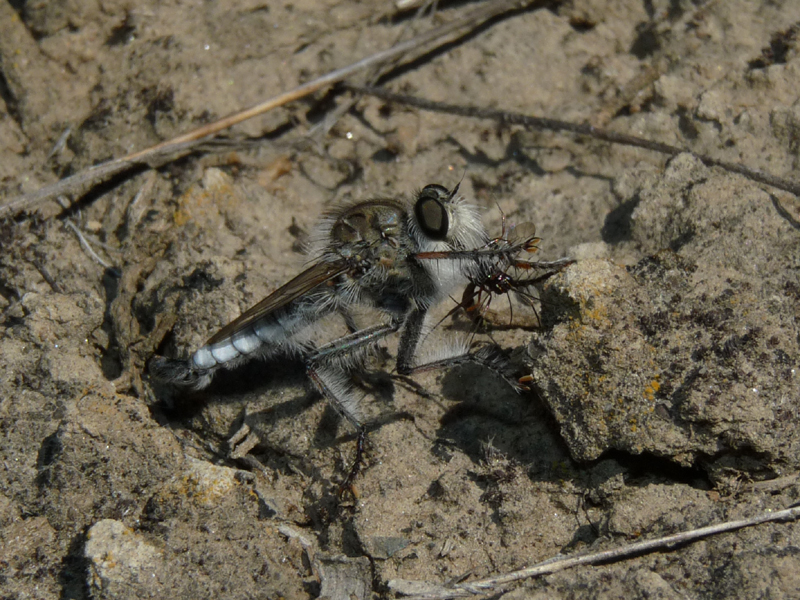
Butterflies were not the only insects of interest found in the grasslands.  I have been trying to create a library of robber flies over the past couple of years and it is a rather slow going process.  I now believe this is due to the lack of time spent in the dry interior!  It seemed that every dozen steps I took, I would put up a robber fly.  I photographed several of the encountered robber flies and sent them to Rob Cannings for identification, as they one of his specialties.  Below is a sample of the robber flies encountered and their proposed identifications.

Efferia benedicti (male) eating a small wasp

The pointed ovipositor of this female Efferia benedicti can be seen at the end of the abdomen.  Females in this genus use their ovipositor to lay eggs in the ground or in the grass flower spikes.

Stenopogon inquinatus (male) was an impressively large robber fly that I initially thought was a damselfly!

This female Stenopogon inquinatus posed nicely on some sagebrush

Must be make-up sex... this pair of Stenopogon inquinatus can't even look each other in the eyes!

Efferia staminea (male) posing on pussytoes

Apparently a trickier one to identify, this may be a female Efferia staminea

I documented one last sighting from the edge of one of the alkaline ponds.  While watching dozens of bluets hovering over the shore, I flushed up a noctuid moth.  I followed it until it landed on Red Glasswort (Salicornia rubra) where I was able to snap off a nice shot of it.  I thought the clear photo would make this moth a cinch to identify, but it proved to be extremely difficult.  I think I have finally figured it out thanks to the amazing new Pacific Northwest Moth website (http://pnwmoths.biol.wwu.edu/).  I found a specimen shot of Euxoa tristicula that closely resembles the individual I photographed, and the detailed species account reveals that this species matches in terms of ecology as well.

I'm using to seeing American Glasswort (Salicornia pacifica) on the coast, but it was neat to see the Red Glasswort growing around the alkaline ponds.  The fact that the moth, Euxoa tristicula, used it as a perch was just a bonus!

The Lac du Bois Grasslands Protected Area, despite being fairly dried up, yielded many interesting sightings and I envision it being even more spectacular a month earlier.  If you're passing through Kamloops and looking for a large sagebrush grassland to wander through, this is the place to go!

Thursday, 19 July 2012

Finding Nemophora

Moths are not always thought of as the most charismatic group.  As you may know by now, I think they are quite fascinating.  I don't like to play favourites but I have a special place in my heart for the family Adelidae: the fairy longhorn moths.  They are definitely as whimsical as their names makes them out to be.  The first fairy longhorn moth I ever encountered was at Oak Haven Park in Brentwood Bay.  I noticed a tiny, black moth with three white stripes, a fuzzy red head, and extremely long, gaudy antennae.  At the time I thought most moths were virtually impossible to identify, but I gave it the old college try by perusing the internet.  I managed to determine it was a Three-striped Longhorn Moth (Adela trigrapha).

This angle shows off all the key features of Adela trigrapha, but does not do the antennae justice

A couple years ago, I rekindled my interest in fairy longhorn moths by encountering two more species.  Walking along the railroad tracks near Goldstream Provincial Park, I noticed some tiny moths similar to the Three-striped Longhorn, but they had only two white bands and a series of tiny dots near the tips of their wings.  I went home and determined they were Ocean Spray Longhorn Moths (Adela septentrionella).  The next species was found while bird atlassing along a logging road above Burton Creek south of Nakusp.  At the side of the logging road, I noticed some small moths associating with Holboell's Rockcress (Arabis holboelli).  They had that signature cuter-than-a-button look and fairly long antennae that made me think they were fairy longhorn moths.  I was now significantly more adept at identifying moths and with some research and close scrutiny, I came up with Cauchas simpliciella as the best match.

What's not to love?  Cauchas simpliciella might just be the cutest moth I've ever seen!

I connected with another fairy longhorn moth a couple weeks ago while working in Conklin in northern Alberta.  The species was instantly recognizable as a fairy longhorn due to the long antennae, but this one had a pattern that put the three other species I'd encountered to shame.  I pored over the Alberta checklist of Lepidoptera and was easily able to narrow down the identification as only four species fall under the family Adelidae.  I checked what Nemophora bellela looked like at the Moth Photographers Group and found it was a dead ringer for the individual I had photographed.

The first Nemophora bellela I found was sitting up on Labrador Tea (Ledum groenlandicum)

You have to pay close attention if you're going to spot any of the fairy longhorns, but the reward is worth it.  These small, intricate little moths with antennae longer than their wings are always a delight.

Tuesday, 17 July 2012

First Record of Elusive Clubtail for Alberta

I just started a very exclusive club where all the members have seen Elusive Clubtail in Alberta.  How many memberships have been given out?  Just one... self high-five!

Before heading up to Fort McMurray earlier in the spring, I perused through Dennis Paulson's excellent "Dragonflies and Damselflies of the West" field guide to see if there was any potential to encounter odonates I had never seen before.  I learned that I could potentially see Plains Forktail (Ischnura damula), Prairie Bluet (Coenagrion angulatum), Boreal Snaketail (Ophiogomphus colubrinus), and maybe Forcipate Emerald (Somatochlora forcipata) or Beaverpond Baskettail (Epitheca canis). The distribution map of Elusive Clubtail (Stylurus notatus), however, was extremely intriguing. A slim band running across southern Manitoba appeared to be furthest west portion of its contiguous range, which runs off the map to the east (I need the eastern counterpart guide to see the full extent of its range). After that, three anomalous records with a great deal of distance between them made up the remainder, with a single record above Alberta in the Northwest Territories being the westernmost. I did a mental connect-the-dots and dared to dream.

I never actually expected to find Elusive Clubtails despite letting my mind run wild with the possibility.  The species name alludes to its life history: after larvae in slow-moving rivers climb up onto rocks, the adults emerge from their larval casings (or exuviae), and then fly up into the forest canopy where they spend the majority of their adult life.  Consequently, you have to get lucky and find them emerging or breeding.

This photo illustrates the emergence of an adult from its larval exoskeleton ("exuvia")

I was fortunate enough to have a low intensity day at work, which just required me to run some errands around Fort McMurray on June 30th. I took advantage of this by heading down to a section of the Clearwater River that I visited last year. The weather was quite warm, as it had been for the previous couple of days. When I reached the end of the short trail, I scrambled down some boulders to get to the river's edge and flushed up a very freshly emerged dragonfly. I looked at it with my binoculars and recognized it as a member of the family Gomphidae, and specifically thought it looked like a clubtail. I had seen my first Boreal Snaketails a couple days earlier and had no idea what a freshly emerged snaketail would look like - was this one? I snapped a couple record shots and pondered the perching posture it had taken when it landed. The dragonfly was hanging from a leaf and made me think it was not a snaketail. Rather, it appeared to belong to the genus Stylurus, also known as the "hanging clubtails".

This is a shot of the first individual encountered, which shows why
 members of the genus Stylurus are called "hanging clubtails"

I proceeded to find several more individuals (approximately ten in total) and their similarity to Olive Clubtail (Stylurus olivaceus) - the only other Stylurus I have seen - was remarkable. I photographed a few more individuals, including a couple males that appeared to have slightly more mature colouration, and when I left I was quite confident it was going to be an exciting find.

This male Elusive Clubtail was the most striking individual I encountered.
You can see its wings still haven't fully inflated.

I followed up my sighting by contacting a couple respected odonatologists and they confirmed my suspicion - these were the first documented Elusive Clubtails in Alberta! I still can't believe all the luck that led to the sighting - the weather, the location, and the timing were just perfect! Not only is this the first time I've had a provincial first record, but this species is probably the least understood dragonfly I've ever encountered.  Hopefully this record can be used to build a further understanding of their range from western Manitoba over to the Northwest Territories.

Thursday, 14 June 2012

Trench Fever

Almost a month ago, if you recall, I saw a Sage Thrasher (Oreoscoptes montanus) that had wandered up into the Rocky Mountain Trench and looked quite out of place in the Bush Arm of Kinbasket Lake, northeast of Golden.  The wave of interesting Great Basin species this spring in British Columbia left me optimistic that my work trip back in the Rocky Mountain Trench - the Golden-Mica Creek-Valemount circuit - might turn up an interesting bird or two.  My optimism was elevated even further when I received an e-mail from James Bradley with a photo attached depicting a female Lark Bunting (Calamospiza melanocorys) found in Valemount.

The deck seemed to be stacked in my favour, so I birded from the Monashee Lodge to the Mica Creek camp after putting in a wet work day.  I was interested in wandering around the Mica Creek camp because it seems to pull in some interesting birds due to the matrix of disturbed habitats around the buildings (including a small golf course).  Last year I saw a rather lost-looking Yellow-headed Blackbird (Xanthocephalus xanthocephalus) feeding around the buildings, and a few years ago Jamie Fenneman had a male Rose-breasted Grosbeak (Pheucticus ludovicianus) there.

Once I reached the camp, I was immediately rewarded with a female Lazuli Bunting (Passerina amoena) feeding on a lawn near a flock of Brown-headed Cowbirds (Molothrus ater).  I am not used to seeing Lazuli Buntings hopping around on the ground in the open, so I followed it for a bit and took a couple photos.

The tawny wash, bicoloured bill, and white wing bar peg this rather drab bird as a female Lazuli Bunting.  She's definitely not as flashy as the male counterpart.

The Lazuli Bunting flew a short distance around the corner of a building into another lawn area with gravel patches.  I was distracted for a minute by writing down other species, then turned back to the bunting and noticed there was another bird nearby.  When I focused my binoculars on it, I was surprised to see it was a stunning male Lark Sparrow (Chondestes grammacus)!

Lark Sparrows seem to turn up in weird places in the spring in British Columbia.  Considering their breeding range in the province is primarily in the Okanagan, they should be looked for anywhere between the coast and the Rockies.

As you can see, Lark Sparrows are quite striking with their bold black, chestnut, and white face pattern.  They are definitely one of the nicest sparrows going in the province and it's always a treat to bump into one!  The Trench Fever is running strong these days.  It truly feels like you can just walk out the door and encounter just about anything.  Maybe this will be my good bird of the trip - I'm definitely alright with that!

Saturday, 9 June 2012

Sedges have edges, rushes are round... both are rare!

We're not talking just any old sedges and rushes here.  I ventured back to the Garry Oak meadows today near the Victoria waterfront in search of some rather inconspicuous rare plants.  I really didn't even know what exactly I was looking for from a visual standpoint, but I knew Kellogg's Rush (Juncus kelloggii) and Foothill Sedge (Carex tumulicola) were there to be found.  I even called up Jamie Fenneman to get some descriptions - one of these days I'll join the smartphone era and look up information for myself while out in the field.  Regardless, the descriptions seemed to work because I found both of my targets.  I also knew Heterocodon (Heterocodon rariflorum) and Tall Woolly-heads (Psilocarphus elatior) could be found in the park, and Jamie also mentioned that I should keep an eye out for Muhlenberg's Centaury (Centaurium muehlenbergii).

A section of wet meadow with vernal pools (now dry) hosts several plants that are rare in Canada, so I focused my search in this area.  Kellogg's Rush looks quite inconsequential - it is tiny and was a bit of a needle in a haystack set within a carpet of Toad Rush (Juncus bufonius).  After an extensive scan, I eventually found an area with some small plants that appeared to be something other than Toad Rush.  I took some photos of these plants in hopes they might be the holy grail.  I was briefly worried that I was confusing Kellogg's Rush with Slender Plantain (Plantago elongata), which grows in the same area and has a vaguely similar appearance.  There were some noticeable differences, but it certainly added an extra level of complexity to my search.  For reference, this is what Slender Plantain looks like once it is in fruit.

Slender Plantain typically has several pinkish fruits, a slightly hair stem, and the fruits are more pointed compared to Kellogg's Rush

I wouldn't know the results until I got home and referenced E-Flora, which is a fantastic online provincial reference (http://www.geog.ubc.ca/biodiversity/eflora/).  The photos on E-Flora revealed my rush is a dead ringer for Kellogg's Rush!

Kellogg's Rush is known only from one locality in Canada but may be overlooked due to its size

My search for Foothill Sedge was less directed.  I didn't know what habitat to look for it, so I just based my search on sedges and looked for features Jamie had informed me were diagnostic.  I eventually found one that I thought fit the bill.  Once again, a look on E-Flora confirmed I had nailed it.

I can hear you all oohing and ahhing at the majesty of Foothill Sedge

Near the Kellogg's Rush, I did manage to come across one Heterocodon.  Unfortunately it is still a little early for this species, so I was looking at a just a couple leaves.  I'm really not selling the excitement of rare plants here!

The plant in the centre with toothed leaves wrapping around the stem is Heterocodon,
which will look more impressive when it gets its purple flowers

The Tall Woolly-heads were no problem to find.  They are quite obvious and create a silvery-green carpet in some of the wet depressions.

You can get a sense of why they call these plants woolly-heads in this shot

Here is an example of a patch of Tall Woolly-heads carpeting a wet depression in a Garry Oak meadow

Along the waterfront, I checked in on Purple Sanicle (Sanicula bipinnatifida), which is another rare plant.  We really live in an area that is rich in rare plants, some of which would be scarce in British Columbia and Canada regardless of development.  Others have dwindled due to the extensive loss of habitat.  Purple Sanicle is quite rare, and most populations are limited to just a handful of plants.  This species can be inconspicuous until its purple flowers come out.  The leaves are diagnostic, but they don't stand out unless you're looking for them.

Close-up of Purple Sanicle's flowers

In this photo, Purple Sanicle is growing with Pacific Sanicle (Sanicula crassicaulis), left,
and Indian Consumption Plant (Lomatium nudicaule), bottom right

The scientific name "bipinnatifida" refers to the leaves being twice pinnate,
which is starting to show on some of these Purple Sanicle leaves

Just to make sure this entry doesn't alienate those that prefer animals, I'll add a shot of an Orange-crowned Warbler from Christmas Hill earlier in the morning.

This Orange-crowned Warbler was feeding in Garry Oaks

There's lots to see out there right, rare or not, so get out and enjoy the sights and sounds of your favourite local haunt!

Tuesday, 22 May 2012

Jeremy and the Golden Thrasher

This is destined to become a tale of legend not unlike Jason and the Golden Fleece.  Actually, none of my adventures are destined to work their way into local folklore.  They will almost certainly just fade into the internet ether.  Enough of that depressive musing about not having a legacy... rare bird story time!

I was doing some work in the Bush Arm of Kinbasket Lake, northwest of Golden, when I encountered a bird a little off course.  In the spring, Sage Thrashers can turn up just about anywhere.  Anywhere can be the middle of nowhere and that's exactly where I was!  While doing surveys on May 18th, my co-worker said "What's that?", pointing at a tan-coloured bird approximately 50 metres away.  I shot up my binoculars and caught a quick glimpse of the bird hopping up to the base of a cedar stump, cocking its tail once and then vanishing under the stump.  I was thoroughly intrigued so I dashed over to further investigate.  As I swiftly walked towards the mystery bird, two American Pipits flushed up and made me wonder if my sanity was in check.  That wouldn't make sense for what I saw!  The bird then popped out on the other side of the stump and for a split second I thought it was a female Mountain Bluebird because I wasn't ready for such a rarity. My binoculars went up and my jaw went down... a Sage Thrasher had wandered up the Rocky Mountain Trench and ended up right in front of me!

This Sage Thrasher (Oreoscoptes montanus) definitely looked out of
place running from cedar stump to cedar stump like a roadrunner!

I have only seen Sage Thrashers in B.C. a handful of times within their very restricted breeding range.  I have seen them once or twice on Nighthawk Rd. (west of Osoyoos), once or twice at White Lake (southwest of Okanagan Falls), and once on Anarchist Mountain (east of Osoyoos).  The advantage of seeing them in a very open landscape is obvious - I was able to watch the thrasher running across open patches!  I have heard of other species of thrashers doing this, such as LeConte's and Crissal, but I didn't know Sage Thrashers did it.  It was very cool to watch.  It would raise its tail and take long strides as it scurried through the open, which seemed almost roadrunner-like.

I have been fairly lucky the last few years with rare birds found during work.  In 2009, I serendipitously found a singing Northern Parula and followed it up with a male Chestnut-collared Longspur a couple days later while working south of Nakusp.  The next year, once again working south of Nakusp, I had a Red Phalarope in the fall which is an excellent bird to find away from the coast.  With a Sage Thrasher already under my belt for 2012, it's hard not to be optimistic about the prospects of another exciting find!  As it stands, I feel I can run off the seratonin from the thrasher sighting if nothing else materializes this year!

Saturday, 12 May 2012

Interiorly Decorated

How ironic... or something resembling irony!  On International Migratory Bird Day, two species decided to show us they are not so apt at finding their normal range.

I woke up early this morning after getting to bed earlier than usual last night, so I opted to go for a walk at Saanichton Spit.  The spit was deader than I've seen it in ages, so I decided to make tracks and head out to the airport.  I had nearly finished my circuit around the airport when I made one last stop just east of the terminal.  I scanned out over the fence lines and fields and noticed a hawk low over the field.  I thought "Hmmm... that has quite the dihedral going on!"  When it banked, it showed black primaries and secondaries - it was a classic light phase Swainson's Hawk (Buteo swainsoni)!  I hopped out and put it in the scope and saw other key features, such as a brown hood, a clean white chest, and a sandy grey-brown back.  I even watched it dive into the grass a couple of times in hopes of snagging a vole or a snake!  I called up Jeremy K. and he was in the exact spot he didn't want to be at that moment, which was smack dab on the top of Mount Wells.  He booked it down the mountain, met me at my place and we zipped out to the airport, which ended up being a shade under two hours since I last saw the bird.  We pulled over at the spot I had originally seen the hawk and started scanning - is it that one?  Nope... Red-tailed Hawk (Buteo jamaicensis).  That one above it?  Nope... another Red-tailed Hawk.  How about the one over the control tower?  Yes!  We watched the light phase Swainson's Hawk wheeling around over the fields for a couple minutes before noticing another interesting dark phase hawk.  It had several features in line with the light phase, but its chest was uniformly chocolate brown.  When it banked and showed its back, we could see it was the same sandy grey-brown colour as the light phase's and it graded abruptly stopped at the blackish primaries and secondaries.  Additionally, the tail didn't have a trace of rusty-red like any of the dark version of Red-tailed Hawks.  After watching it for a while, we were quite certain it was another Swainson's Hawk!  Below are pictures (not great) of the two different Swainson's seen today.

Light phase Swainson's Hawk - no doubt about this classic bird!

Dark phase Swainson's Hawk at the Victoria International Airport - note the white undertail coverts (if you squint)

I managed to capture the light phase and dark phase Swainson's in the same frame for comparison - awesome!

We continued on to the Vantreight bulb fields where things were slow, then Jeremy K. abruptly said "We have to go!"  I thought that was a tad urgent, but I knew he had early afternoon plans.  He then clarified by turning his phone to show me a message indicating there was a Wilson's Phalarope (Phalaropus tricolor) at Panama Flats.  We turned tail, hopped in the car, hit the highway, and made our way out to the flats.  We luckily picked the right corner of the flats and were soon looking at two female Wilson's Phalaropes!  What a great day of birding with two species normally found in the interior of the province!  And two of each to boot!

One of the Wilson's Phalaropes in the southeast pond at Panama Flats

Female Wilson's Phalaropes exemplify a rare case (aside from humans) where the females are more striking than the males.  Their mating system is polyandrous, which means there is a role reversal where males perform most of the parental duties while the female competes for mates.